
By Dan Stoneking
Public discourse is the communication that shapes or challenges our shared beliefs and norms as a society. Or at least that is what it is supposed to be.
Public discourse in the United States today is heavily polarized, contentious, and characterized by a significant decline in civility and fact based communication. And in full disclosure, and not a small amount of shame, like millions of others, I have contributed to that. But I am looking in the mirror and asking for change.
Ironically, there are a few things we are not debating. We agree that we live in an environment of high polarization. We acknowledge the role of technology, social media, and mainstream media in the degradation of civility. And yet we continue to engage at a level of submediocrity, often shrugging with an “it is what it is” resignation.
I am a professor teaching Public Speaking at West Chester University in Pennsylvania. During our final projects, my students taught me something I did not expect. I assigned a four to six minute Speech to Persuade, focused on encouraging some form of good in the world. Local or global, practical or ambitious, the requirement was simple. It had to point toward something better. Controversial topics were allowed because good people can make persuasive arguments on different sides of the same issue. That is precisely what makes them controversial.
I required topic approval before research for two reasons. First, I wanted variety so students would be exposed to different ideas of “doing good.” Second, I wanted to avoid topics that did not meet the assignment’s intent. Almond Joys versus Mounds, for example, does not rise to the level of persuasion I sought. Sometimes you feel like a nut. Sometimes you don’t.
Then something unexpected happened. In all three of my classes, three different students, with no coordination, chose the same topic. They each wanted to persuade others to be more respectful when discussing politics. I approved all three. Later that night, I could not stop thinking about it. Not because it was surprising that students cared about respect, but because it had never surfaced like that before. And now it was everywhere.
Shortly after, in another class, a student approached me about an abortion topic but hesitated. She assumed the class would already agree with her and therefore there would be nothing to persuade. I told her that assumption was unlikely to be correct. Then, on impulse, I asked the class a simple question. No pressure to respond, but a show of hands if willing. Pro-life or pro-choice. A few responded on each side. Twenty three of twenty seven did not respond at all.
That moment clarified something for me. Silence is not neutrality. It is often distance.
At the next session in all three sections, I wrote four phrases on the board.
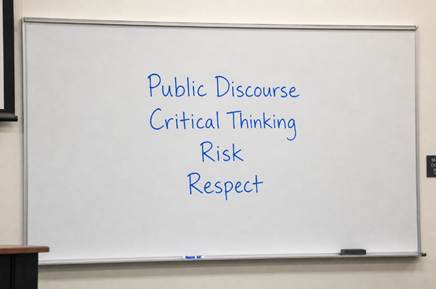
Then I told them what I was seeing and asked them to help me understand it. The discussion that followed became one of the most honest classroom experiences I have ever had.
Public Discourse. The students quickly agreed that the current state of public discourse is a problem. Many said they avoid conversations with people who disagree with them. They described political conversation as emotionally charged, exhausting, and often pointless. Some blamed politics. Some blamed social media. Some blamed artificial intelligence. No one disagreed that the environment itself feels increasingly unhealthy.
Critical Thinking. We defined it together, eventually agreeing that it includes the ability to change your mind when presented with new evidence. I then asked a simple question. If you agree with 72 out of 75 positions in a political platform, can you honestly say you agree with everything that party represents. Then I asked if full agreement with every position is even statistically plausible. The room understood the point immediately.
Then I asked if they could publicly say they agree with 72 out of 75 positions while acknowledging disagreement on the rest. Most said no. Not because they lacked conviction, but because of fear. Fear of being mislabeled. Fear of being judged. Fear of misunderstanding. Fear of social consequences.
That brought us to risk.
Risk. The risk was not physical harm in most cases. It was social cost. Reputation. Identity. Belonging. Being reduced to a label instead of being understood as a person with layered views. The consensus was clear. It would be easier to engage in public discourse if respect was more consistent on all sides.
Respect. This one surfaced quickly and honestly. Students gave examples of how language is used to dismiss rather than engage. Labels on the left. Labels on the right. The details differed, but the pattern did not.
What stood out most was not disagreement. It was agreement on one point. We should treat people with respect even when we strongly disagree. Respect is not agreement. And tolerance does not mean tolerating intolerance. We can reject ideas without dehumanizing the people who hold them.
At that point, something became clear in the room. If we want to do good in the world, we cannot keep reinforcing a cycle that discourages honest engagement.
What now. The final question was whether this dynamic can actually change. Nearly every student believed it could. One did not, arguing that technology and polarization will only intensify and that individuals are too small to matter against it. Others pointed to history as evidence that social behavior does change, sometimes dramatically, when enough individuals decide it must.
We then discussed how change might begin. Not in institutions. Not in media cycles. But in behavior. In real time. In individual choices. Speak with courage, but also with restraint. Focus on issues, not identities. Apply critical thinking honestly, including the willingness to be wrong. Be aware of confirmation bias. And recognize when a conversation has crossed into disrespect and have the discipline to step away.
Those conversations took most of a class period. I asked if it was worthwhile. Every student said yes. It was the best classroom experience I have ever had.
And now, as the semester has ended, I find myself back where I began. Looking in the mirror. And challenging myself to be what I just asked them to consider.
And here is the part we cannot keep postponing to someone else, somewhere else, or some future version of ourselves. If this kind of discourse matters at all, then it has to change in the only place it ever truly does. In real conversations, with real people, in real time. Not after the next election. Not after the next outrage cycle. Not when things finally calm down. Now. Today. The next time we are tempted to label instead of listen, dismiss instead of engage, or perform certainty instead of practicing curiosity, that is the moment the cycle either continues or breaks. No institution is going to do that for us. No algorithm is going to fix it for us. It will only change if enough of us decide, independently and immediately, that we are done participating in the erosion of each other’s humanity. The work is not abstract. It is right in front of us, and it starts the next time we speak.
And I am still looking in the mirror.

