I was eight years old when I finally got the nerve to ask my Mom about the three voices in my head. She and I were walking to Dart Drug. Just the two of us. She held my hand. I was the youngest of four at the time and I felt special taking this trip with her without my brothers and sister vying for attention. It was a rare opportunity. With more than a little hesitation, I mustered up the courage, “Mom, is it normal to have three voices in our head taking to us?”
She stopped in her tracks, turned to me quickly, clearly with concern in here expression, “Danny, what do you mean about these voices? What do they say?
I felt like I was already committed, so I just told the truth, “It’s always something different, but usually one voice will tell me I should do something, and the other voice will tell me I better not or I will get in trouble.”
She took just a second to process, looked relieved, and grabbed my hand as we started walking again while she explained how that was just my conscience, everyone had one, and it was perfectly normal. I began to relax too, happy to be normal.
We took a few more steps when she stopped again as it dawned upon her, “You said three voices, Danny. What is the third voice?”
I didn’t have time to worry or think, so I stuck with the truth, “Oh, he’s the referee!”
She started giggling, then laughing. It was contagious, so I laughed with her. Even after we had arrived at the Dart Drug, I would see her cover her mouth to keep more giggles from escaping. I didn’t fully appreciate the humor at the time. I was too focused on embracing being normal.
If you fear public speaking, if it makes you nervous, you are normal too. You have probably read articles, or books, or at least sought out advice. And it probably didn’t help much. One voice in your head will plot ways to get out of it. A second voice will try to explain that you have an obligation. The referee will likely side with the latter and you are stuck with moving forward. But you aren’t stuck. Don’t look at it as an obligation. It is an opportunity to embrace. I was talking to my daughter Chloe about my drafting this piece while we were driving home last night, and she said to me. “nothing is possible without communication.” If she gets it at 11-years old, we should all get it. We need two of the three voices to favor speaking, to tell the story, to breath life into the hard work and accomplishments of the organization.
Pundits will tell you tons of things, and most of it is correct, but if it didn’t leave you with hitting a home run, it all might have been insufficient. Practice, they will tell you. But the truth is, that works for many, but for many others it creates a rut of trying to memorize some no-existent perfection and everything becomes dull and rote. Make them laugh, others will suggest. Now you have two challenges to stress about. Don’t read the slides word for word, some will scold. Well, that one’s completely right. Don’t be that person. And a bunch of people will tell you either why you should not be nervous and/or how you can mitigate your fears. I don’t buy that one at all.
In the end, I’m just an introvert with 35+ years’ public speaking experience. I have a hard time one-on-one, especially with new people. But I have been pretty successful behind a lectern and on a podium. Here are my five tips. There may be a few parallels to other advice you have received and/or one or more may be counterintuitive. But you have read this far, and nobody has ever given you these top five tips. I triple-dog dare you to try them next time and see if they make a difference.
Embrace Nerves. Trying to get rid of them is a complete waste of effort and can be draining. Moreover, they are actually your friends. Mark Twain was nervous. Martin Luther King Jr was nervous. Stick with the greats. Your nerves become adrenaline. Adrenaline becomes energy. It is one of the reasons I always advise clients to do live television instead of taped. When it is not live, people tend to relax, lose energy, and get lulled into a false sense of security. You don’t want that. You want the nerves. You want the excitement. You just don’t want to fail. Four more simple points and you won’t.
Water and Air. Right before you take the stage or sit for an interview, take a good long sip of water and then take a deep breath. Breathe in through the nose and out through the mouth. Repeat if necessary. When people think about fear and nerves they tend to focus on the psychology. The physiology plays an equally important role. That simple step will reduce (not eliminate) the nerves, while keeping the energy. I could write more about that, but it is simple, not fancy. Just try it.
Tell Your Anecdote. Most people will tell you to tell a story or an anecdote. I tend to be a bit literal, so I would suggest that a story is too long. Takes too much time. An anecdote is defined as “a short amusing or interesting story about a real incident or person.” Every word of that definition is important. Short. I told the anecdote above in 1minute, 20 seconds. If you speak for thirty minutes to an hour, that is more than worth the time. If you are four minutes into a story, it better deliver big and be relatable. It also has to be real. That means it has to be your anecdote. We all have them. If you have been asked to speak it is because you know the content. So, this is the only real preparation you need. Don’t borrow. Don’t make one up. Don’t over complicate it. Just find something that you can connect to what follows. I once told an anecdote about how I found it counterintuitive the first time I made Jello and learned you needed both cold and hot water. Another time I was walking through the lobby of a hotel right before I spoke and there were printed drapes and a printed carpet that didn’t match and yet still seemed to work. I was able to tell each of those in under 30 seconds and relate them to my topic. The final key to your anecdote is to return to it briefly at the end of your speech. Put a bow on it. I think I finished my Jello speech thirty minutes later by telling the audience, “in case you were wondering, it was strawberry Jello, it completely fell apart in the mold, but it still tasted good.” You can do this.
Be Your Truest Self. I have come to learn that many people put on a persona when they are in public speaking roles. It doesn’t work. It is always thinly veiled, and the audience can sense the insincerity. If you are a nerd, be a nerd. If you are an intellectual, don’t dumb down your presentation. If you want it to be more of a conversation, make that happen. Whoever you are, own it. Be honest and self-deprecating. As much as the forum will allow, wear clothes that make you feel good about yourself, down to your favorite socks and shoes. Here is something that I think has set me apart from most speakers – complete candor. Avoid bureaucratic replies. Tell the truth. Tell your truth. Tell it in your words.
Own the Room. Think about this. You are the speaker. They are the audience. If this were a dance, you would be leading. If it was a basketball game, you would be the point guard, and this is your arena. There is a scene in the movie, Fast Times at Ridgemont High where one guy asks another for advice. His friend tells him to just remember, “wherever you are is the place to be and whatever you are doing is the thing to be doing.” This is your place, and you are doing it. That already makes it cool. You define the reality. You are the speaker because you have something to say. They are the audience because they have something they need or want to hear. You know your stuff. Let it shine.
Compare these five tips to other things you have read and heard, take it all with a grain of salt, and then go do you. If you are feeling unsure, if one voice is telling you that you can’t and another voice is telling you that you have to, just turn it over to the referee in your head and go make that speech. See what I did right there?
Editorial note: Sometimes I pause right after I mention Dart Drug and ask if anyone even knows what a Dart Drug is. That achieves a few things, 1) immediate audience participation, 2) builds time and suspense about the three voices, and 3) possibly makes a connection if there is anyone in the audience who does know. Dart Drug was a pharmacy that existed mainly in the Washington DC Area through the 1970’s. Picture a small CVS but with a logo that looks more like Target’s. Furthermore, specifics add color and interest (Dart Drug vs a pharmacy). Why say, “he was chewing gum,” when you can say, “His blue tongue and puffy cheeks revealed that he was still chomping on his grape Hubba Bubba Bubble Gum.”
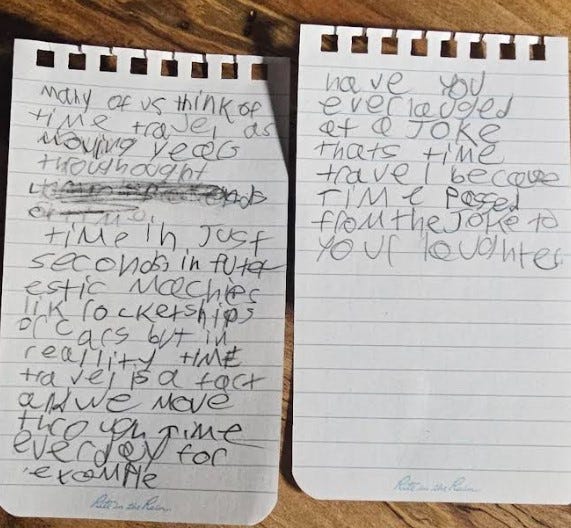
PS. When Chloe and I got home, she immediately went to the kitchen table and started writing. She told me she was writing something that is important to her that people should speak about. I took a picture here and retyped it below. Chloe is listening to the right voices in her head. Are you?
“Many of us think of time travel as moving years through time in just seconds in futuristic machines like rocket ships or cars. But in reality, time travel is a fact, and we move through time every day. For example, have you ever told a joke? That’s time travel because time passed from the joke to your laughter.” – Chloe Stoneking, Feb 12, 2024
###
 Stoneking Strategic Communications (SSC)