When my son was barely becoming a teenager, we had our share of conflict. He was learning to test boundaries while I was trying to reinforce them. He knew all of my triggers. I was getting frustrated in on-on-one between father and son. At some point, we found basketball together. I don’t remember a profound first day. It was gradual. We watched games on TV. We both liked the Celtics. He played in the local league for his age group. So, one afternoon I bought him a basketball stand. We filled the base with sand and set it up together. Not many kids his age lived nearby, so when he asked me to play, I jumped at the chance.
It was a turning point for us. We would play for hours. The first few months, I had him beat. I still had a few inches on him. But as life goes, he kept getting better and I kept getting older. By the time he was 14 years old, he was beating me on a regular basis. But he still wanted to play with me. I couldn’t shoot to save my life, but I gave him solid defense and never went easy on him. We found mutual respect and bonded in a way that has stayed with us all our lives.
When he turned 18, I asked if he wanted to get tattoos together. He was afraid of the needle and possible pain. I would bring it up to him from time to time, but always the same response. So, I was both surprised and delighted when his 38th birthday was near, and he told me that he wanted to get basketball tattoos together. We agreed that they did not have to be the same as each other, as long as both had a basketball theme. When the day came, he got a massive arm sleeve of a slam dunk in action. I was a bit stunned that his very first tattoo was so large, but I was equally impressed. I opted for a basketball on my forearm with an EKG heartbeat running through it. Because when we started playing basketball, I could feel my heart beating for him.
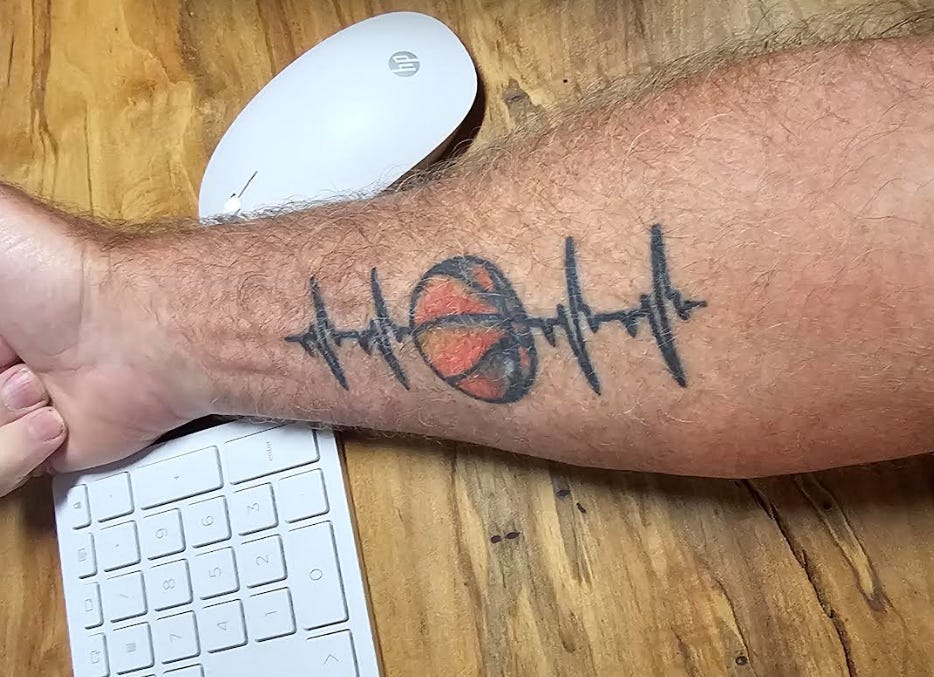
Fast forward to recently, I have been wanting to play tennis, a game I loved in my youth. In my community, just outside my kitchen window, a seldom used tennis court taunted me. I am an introvert, so finding people to play seemed daunting. I finally just put it all out there and posted a note on NextDoor social media looking for players who were as old and rusty as me. In the first day, I found three different players to join me. Once again, I was bonding through sports.
It is true what they say about sports teaching life skills like teamwork, discipline, leadership, goal setting et al. And I have learned some of all of those. But as I progressed in crisis communications, I developed my own theories inspired by these sports. The first is what I call The Juxtaposition of Glass and Rubber Balls. The other is The Ball in Court Theory.
The Juxtaposition of Glass and Rubber Balls
The first things you learn about balls are their purposes and their limitations. You can’t dribble a football well and a basketball won’t fit into a golf hole. The same is true at work. But we only have two balls to worry about, glass and rubber. This starts off simple. If you drop a glass ball, it breaks. If you drop a rubber ball, it bounces. But it gets more complicated.
You may have heard people say at work, don’t juggle or drop the glass balls. But I have a different take on this concept and believe in a deeper strategic dive. In a crisis environment, glass balls can have one or more characteristics. They are often assigned from above. Of course, we are not going to drop a ball from our boss. Pure crystal. Some glass balls are highly visible. You drop one of those and the glass shards go everywhere and may even cut you. And your reputation suffers with everyone who witnessed. When we are directly accountable for something – that is glass as well. If there is a deadline, a performance review, a budget requirement, then we simply can’t afford to juggle. But in crisis communications the most important glass ball, the Swarovski or Baccarat crystal glass ball, is anything that is survivor centric. Lifesaving and life-sustaining glass balls make the others seem like plastic.
Still, rubber balls do not get enough credit. Too often I see people only focus on the glass balls and allow the rubber ones to dribble away. That’s a time management issue and a mistake. Rubber balls are often self-identified. We think of this really cool idea but keep throwing it back in the bag to focus on glass. Even if a rubber ball is not required, they can be incredibly creative and innovative. Another kind of rubber ball are those long-term projects that nobody is asking about. They are rubber until they are not.
I will posit this – that glass balls can get you in trouble, but rubber balls can make you famous. In one of my jobs, I collaborated with a few trusted partners to create the first-in-nation National Business Emergency Operation Center. Nobody asked us to do it. In fact, we had naysayers and obstacles in the way constantly. We could have dropped it at any time, but we prevailed. Since then, I have been asked to speak about it across the nation, more models have copied it, and it has measurably contributed to saving lives.
One of your rubber balls could be a game-changer. Don’t just find time, make time for them.
Ball in Court Theory
Everyone I have ever worked with recognizes that I move at a fast pace. They seem shocked that my email in-box is empty when theirs has 5,000 messages, even though I receive as many, if not more. It is because I use my Ball in Court Theory. If you know who has the ball, where the ball is, and what to do with it, the game speeds up. Tennis works well for this analogy. There are a few clear options while I am on the court. I can serve the ball. I can volley and return the ball. I can let the ball fly out of bounds. The only thing I won’t do is stand there with the ball doing nothing. And yet, we often stand with the ball at work.
As an example, I have seen communicators during a crisis take most of the day to craft a statement or a news release, even when they are capable of knocking it out in 30 minutes. And guess what happens, 20 more balls come their way while they are standing still. But just like the tennis player there are options, whether it is an ask, a task, or some other action – move the ball. You can do that by quickly completing the task if it is fast and easy. You can assign the task (now it is someone else’s court). You can get a colleague to collaborate with and now you are playing doubles, which is much easier. You can ask your supervisor for guidance or clarification. The ball goes back in their court for a bit while you hit other balls. And when it comes back to you, it is an easier ball to hit. You can take a time out on some balls and schedule them on the calendar, so you won’t forget to hit them later.
The same goes for those emails. First, unsubscribe from all the silly distributions you don’t need and never read. You wouldn’t ask your tennis opponent to serve extra balls all at once that are not part of the game. As the real balls come in, either answer them, file them, forward them, or delete them. All four of those options take them to a different court, not yours. There will still be a few big ones left that take time, but now they are not cluttered by all the other balls and improve your focus. And as you finish the day, make sure you address every ball and clean out the inbox. You wouldn’t leave four cans of Wilson U.S. Open Tennis Balls on the court at the end of the game.
This was my rubber ball for the day, and it is no longer in my court.
For my next tattoo, I am thinking about representing tennis. Maybe just a rubber ball?
###
 Stoneking Strategic Communications (SSC)