All this talk about Critical Thinking. Blah, blah, blah. Critical thinking is the objective analysis and evaluation of an issue in order to form a judgment. It typically includes observation, analysis, inference, problem solving, charts, and statistics. Some people refer to it as Strategic Thinking. You say tomato; I say I’m allergic. A rose by any other name would still be a waste of time.
Because every single one of us are critical thinkers. My middle school daughter, Ivy, is a critical thinker. She observes that there is a Friday night high school football game, she analyses previous ploys she has used to get me to say yes. She problem solves with her friends on various tactics. She weighs the pros and cons, often based on statistical success and failure of previous efforts, and she comes to a judgment.
My new puppy, Fiji, is a critical thinker. Using many of the same elements, when she wants to go out, she knows that a whine is effective. When she wants to eat, she has learned that licking her empty bowl can do the trick. And when she wants to snuggle, she has identified the path underneath the coffee table, up on to the couch, and into my lap.
Like virtually all of us in our personal lives, they then take the simple step from thinking to doing. They do it. We all do it… at home. But look around your office tomorrow. Everyone you see is a capable critical thinker. And at home, they are critical doers. They manage bills. They take vacations. They resolve conflicts with significant others. They figure out how to make dinner.
But then, so many come to work with their critical thinking hidden away like a treasure, never exposing themselves by the critical doing. Look around. You can name them in your office.
So why do they choose not to take that tiny step from thinking to doing? Maybe they think it is a leap. Maybe they aren’t invested. That is all part of it, I suppose. But I think the biggest reasons are that either a) they don’t know how, or b) they fear failure, and/or c) they don’t recognize that success is within their grasp. Teaching critical thinking that they already know does not solve that. They need to learn critical doing.
How to Succeed at Critical Doing Without Really Trying
Movie Critic: It’s fun to be a movie critic. Do it at work. You can call it devil’s advocate, or naysayer. I just think movie critic sounds better. Evaluate the movie you are watching in that work meeting. Dissect it. Look for flaws. Figure out a better ending. And then go do it.
Factually dispassionate: It is hard to do things well when we are too emotionally invested sometimes. Being factually dispassionate means take away the adjectives and adverbs and address the facts without emotion. This makes it easier to then do something.
Justification: Come up with a justification before you do something. If you can come up with three good reasons to do something without meaningful reasons not to do that something, you have found a safe do to do.
Source documents: Sometimes people hesitate to do so because their data input comes from what other people are saying. We see this on social media all the time. If you are confronted with a report, procedures, some kind of plan, or even the U.S. Constitution or Bible – go read the source document. More often than not, you will be the smartest person on the subject. That makes doing much easier.
Brainstorm: Either by yourself or with trusted allies, brainstorm a dozen different do’s and do the easiest do first.
Triggers: Whenever you hear phrases similar to “That’s the way we have always done it,” “that’s just the way I feel,” or “I hear you, but I prefer this option,” then you have discovered that they have no tangible critical thought behind their view. That’s an opportunity to turn your thought into doing.
How to Overcome Fear of Failure and Grasp Success Without Really Trying
Everyone is afraid: How many people are with you in the conference room? Seven? Seven are afraid. How many people are on the football field? Twenty-two. Twenty-two are afraid. Once you grasp that, there is no stopping you. Clearly other scared people are doing. Hop in and join them.
Soccer Ball: When two opposing players in soccer both go to head or kick the soccer ball at the same time, it is the one who hesitates who gets hurt. If your fear is winning right now, then you are hesitating. You would be safer if you were doing something and kick the ball first.
Digestible portions: I’m not advocating that you tackle the biggest problem at work tomorrow. Start small. Do something small tomorrow that you otherwise would not do. Work your way up. Every day you do something without repercussions reduces future fear.
Worst case scenario: This doesn’t always work for everyone all the time, but I find it comforting. If the worst-case scenario is getting fired, it’s probably a good idea not to start there. If the worst-case scenario is Karen in accounting thinking what you did was stupid, you can handle doing that. Nobody likes Karen in accounting anyway.
Make a friend: With any luck, you are already in better shape than me and have a friend at work. If not, try to make one. Share some snacks. Complement their ideas in meetings. Once you are friends, do something together. Easy peasy lemon squeezy. Oh, and making a friend is, in fact, doing something.
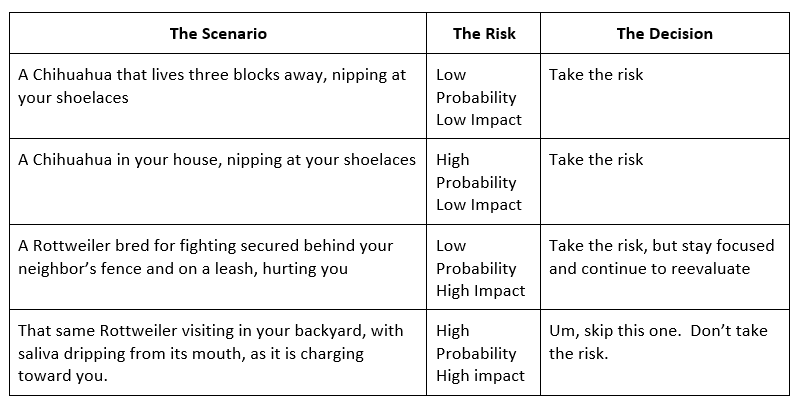
Risk assessment matrix: Identify the scenario where you may do something. Identify the probability that you will be exposed for doing and the negative impact of any response and make the right decision on whether to do from the matrix. Oh, look, I made one for you. You want to do something and move into a neighborhood with dogs.
Reward yourself: I recently told myself that if I completed a writing project, I could buy myself an extra monitor. After having dual monitors at work, I got so used to the set up and missed it every day. I did the project. The extra monitor is sweet.
Self-affirmation and breathing: I know many people think these are goofy and meaningless. I used to be you. I was jaded and self-reliant. I guess I still am. But I started reading these on social media, printed some out and posted them where I would see it, and whodathunkit, but gee, they make me feel better. If you don’t believe me, ask Stuart Smalley, “I’m good enough, I’m smart enough, and doggonit, people like me.” And the breathing too. Recently, I did a spoken word event for the first time. Three deep breaths before I hit the stage, and I was fine. Maybe it was three deep breaths and a beer, but still.
I wrote this whole piece without writing do do. Doh. I would love to do some more doing here, but I have to go do some dog walking and purchase some football tickets.
###
 Stoneking Strategic Communications (SSC)