Have you ever had one of your kids in braces? It puts a bit of a dent in the piggybank. I have had the older one in braces for three years, while the younger one has been wearing some kind of face guard that I don’t fully understand. Now the older is about to come out of braces just as the younger one goes into them. So, that expense will entertain me for about six long years. And there really is some entertainment. Their orthodontist sends regular emails to all us clients with nice pictures and often interesting factoids. Today’s email shared the following:
What people most notice when meeting other people:
Smile 47%
Eyes 31%
Smell 11%
Clothes 7%
Hair 4%
Compare all of that combined physiology to tone and words, I have seen estimates that what impacts audiences the most by percentage are:
Physiology 55%
Tone 38%
Words 7%
I doubt anyone reading this needs a tutorial on the different examples of non-verbal communications. Powerful stuff. Maybe even more powerful is how much we can determine just by looking at one’s eyes.
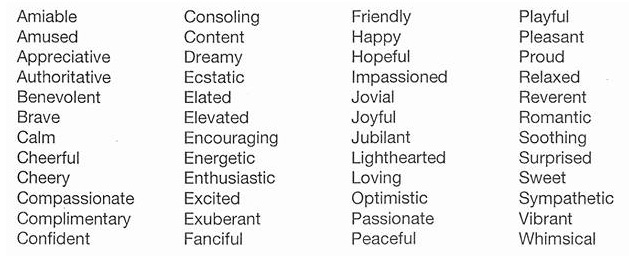
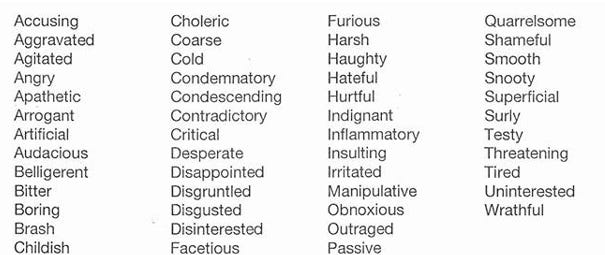
Now let’s throw in some different aspects of tone, like pace, inflection, pauses, repetition, energy, cadence, and articulation. Our tone alone can evoke all kinds of emotions. Some can be positive…
And some can be negative…
Here’s a fun exercise for training – fill one box with dozens of examples of nonverbal communication and another box with dozens of examples of tone. Have each participant take one out of each box and act it out. You will likely find that the audience can pretty often guess the characteristics. Beyond that, sometimes they will be contradictory and other times they will be complementary. For example, they may get sloppy posture and bad eye contact combined with a passionate, energetic tone with a fast cadence. Very confusing. On the opposite spectrum, one might draw a nice smile and professional dress combined with an articulate tone that is confident and soothing. In this case they complement each other.
But here is the kicker, the $64,000 question. When crisis communicators prepare their leadership for interviews, with talking points in hand (the words), how much time, if any, is spent providing guidance on nonverbals and tone? Usually very little. And if you are in the very small minority who addresses nonverbal and tone, how much time do you give it compared to the words? Be honest. And yet, if the psychological statistics are even remotely close to accurate, the nonverbal and tone account for so much more than the words. We might have our priorities bass ackwards. At a minimum, most crisis communications training and interview preparation could dedicate more time to these factors. If we are willing to tell our boss what to say, we should also be willing to tell them respectfully that they slouch, have poor eye contact, and talk too fast. At the same time, it is a great opportunity to reinforce those nonverbals and tone they do well.
I would write more words, but often times it is less about what we say.
###
 Stoneking Strategic Communications (SSC)